Live Online Lessons vs Self-Paced Learning in Virtual School

5 min to read
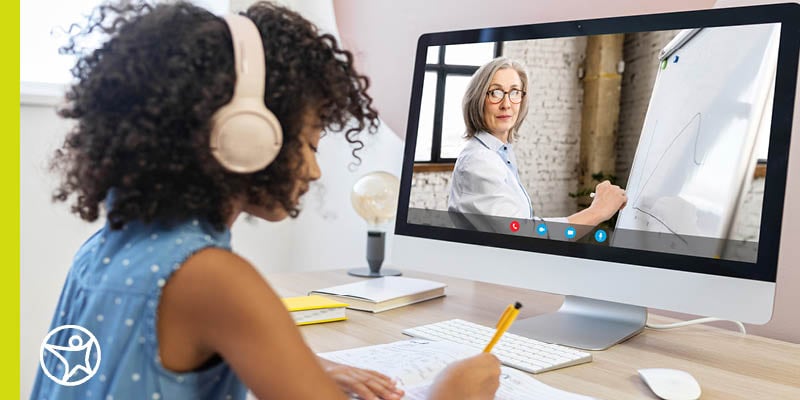
A high school student wearing a blue shirt watches an online lesson on a monitor while wearing headphones.

From brick-and-mortar public and private schools to online schools and homeschooling, today’s parents have a lot of options when it comes to finding the best learning environment for their child. Making that choice can be a bit overwhelming, though, especially for families who may only have experience with in-person school options. 

For families interested in remote learning options for their child, a question they often have is how exactly students learn in online school when it comes to teacher-led LiveLesson sessions and self-paced learning.

How Online School Works: Synchronous and Asynchronous Learning

Accredited, online K-12 schools like Connections Academy and Pearson Online Academy use a curriculum designed for online learning that meets strict accreditation standards and state graduation requirements. With that, comes a learning schedule flexibility that allows students to complete their coursework and lessons throughout the week at the time most convenient for them, whether that be in small spurts throughout the day or all at once in the mornings or evenings. 

It all comes down to a mix between the two main online class formats: synchronous learning and asynchronous learning or LiveLessons vs self-paced learning. 

What are LiveLesson Sessions Like?

LiveLesson sessions are virtual classes that typically last for one hour led by a teacher in real time. The teacher is on camera during the class, and students are encouraged to be on camera as well, though it is not required. 

During a LiveLesson session, teachers review lesson materials, lead instruction in new content, engage students by asking questions in real time and guide them in applying their learning through interactive activities. Students can raise their hands, ask questions, and respond to their teacher using a microphone or through chat. 

Students can also participate in group work during LiveLesson sessions. They meet with classmates in breakout rooms to work on assignments together, then rejoin the full class when they are finished.  

LiveLesson sessions are scheduled at different times throughout the week so they can attend based on their other courses.   

What Is Self-Paced Learning?

With self-paced learning, students work through their coursework at their own pace and on their own schedule. They don’t attend live classes and therefore aren’t tied to strict class start times. 

Because LiveLessons are often recorded, students who prefer self-paced learning can still benefit from the teacher-led instruction that happened during the class. Self-paced learners can also connect with their classmates through the class message board and connect with their teachers for learning support during office hours should they have any questions about the learning material. 

The Benefits of Live Lessons

LiveLesson sessions bring classmates together in a live virtual environment, where they can interact with their teachers, meet new friends, and make connections as they learn. Students attending LiveLessons also benefit from: 

  • Receiving immediate feedback by asking their teacher questions.

  • Gaining a deeper understanding of the content. Developing soft skills, including communication, active listening, teamwork, adaptability, and leadership.  

  • Building time management skills by ensuring they are prepared for their classes and attend them on time.

The Benefits of Self-Paced Learning

Self-paced learners are motivated and disciplined and can complete their lessons based on their own schedule. They work with their Learning Coach—often a parent or caregiver who supports them and helps them stay on track—while connecting on their own with their teacher for learning guidance and to ensure they are meeting the class requirements.

The benefits of self-paced learning include:

  • Control Over Learning by spending as much or as little time on each lesson that they need, especially on subjects that may be more challenging. 

  • A Personalized Learning Experience, which allows teachers to tailor lessons to meet each student’s unique learning style, especially if they are behind, ahead, or in need of learning accommodations. 

LiveLesson Sessions vs. Self-Paced Learning: Which is Better?

LiveLesson sessions and self-paced learning both offer benefits to students – plainly, one isn’t better than the other. Choosing to attend LiveLesson sessions or listen to a recording and learning at their own pace is completely up to each student and their Learning Coach. 

Students are also welcome toenjoy a mixture of both learning methods. They can attend LiveLesson sessions one week if their schedule allows and listen to the recording other weeks when they can’t make the live classes. It all depends on what works best for the student and their family’s unique preferences, abilities, and situation. 

Learn More and Enroll 

To learn more about virtual online classes, self-paced learning, and all of the benefits of online school, request more information about Connections Academy or attend an information session. You can also start the enrollment process online. 

You can also request more information about Pearson Online Academy and start the admissions process. If you have questions about Pearson Online Academy, you can contact them at 1-877-804-6222.

E-guide for Connections Academy with a green background and a graphic of a laptop with the purple eGuide.

Ready to Learn More

About Connections Academy?

Explore the benefits of attending Connections Academy, a tuition-free, accredited online public school that’s passionate about helping your child thrive.  
Get Your Free eGuide


Related Posts

  • The 5 Main Benefits of Attending Online School

    by Beth Werrell

    middle school girl sitting on floor with laptop

    While many parents are more familiar with the routines and methods of a traditional, brick-and-mortar public school, online public schools offer a high-quality education as well as appealing differences. Although families mention a variety of reasons for leaving their previous school or schooling method, they quickly identify five main benefits of attending a virtual school.

    More Flexibility to Meet Students’ Needs

    Traditional brick-and-mortar schools can be challenging for aspiring athletes, actors, artists, and those heavily involved in extracurricular activities to find a balance between school and their interests. Many students in such situations devote significant time to travel, practice, and other requirements to meet their goals. Online schools offer flexible schedules that fit school to the student—instead of fitting the student to the school.

    That said, everyone can benefit from the flexibility of virtual schools. With this model, it’s simple to accommodate doctor’s appointments, volunteering, part-time jobs, and other commitments. In addition, students switching from being homeschooled may find online school to be a good choice—and a smooth transition.

    The flexible schedule also allows students to move at their own pace. Students at virtual schools don’t have to wait for other students to catch up or worry about rushing through a difficult concept. This flexible pace allows for mastery of material on your student’s terms.

    A Chance for Homeschool Students to Learn at Home with a Proven Curriculum

    Whether you are a current homeschool family or thinking about homeschooling, online public school can be a great option for you to consider. With online school, you don’t have to find materials and make sure your child has a well-rounded and complete education. And you don’t have to take on the job of a full-time teacher. There are certified teachers who support your student’s learning with a proven curriculum in all core subjects and electives.

    With online school, you can still play an important role in your child’s education as the learning coach—monitoring progress, keeping your student motivated, and participating in your child’s daily learning. As a parent, you know how quickly the K–12 school years fly by; online school lets you be involved and keep your child close by, in the safety and comfort of your home.

    Fewer Distractions and Time Wasters

    One of the greatest benefits of online learning is having fewer distractions and time wasters.

    With a Learning Coach to monitor progress and keep learning on track, students can focus on their courses without having peers as a distraction. Since your student is at home, there are fewer opportunities for bullying, inappropriate influences, or behaviors you don’t condone. Additionally, online school lets your student benefit from the local school’s curriculum without the wasted time of long bus or car rides, weather delays, roll call, and chatty classmates.

    Put simply, virtual schools are able to tailor education to each individual child. Students aren’t distracted by other students, and their learning isn’t interrupted because a teacher has to address other students’ bad behaviors.

    Opportunity for Struggling Students to Thrive

    Online schools can be an academic lifeline for many students, such as those who:

    • grasp new material faster or slower than other students
    • need the ability to manage health concerns throughout the day
    • are rebuilding confidence after experiencing bullying
    • accrue many absences because of a difficult-to-accommodate schedule

    It also can help decrease sick days, as students can work on school at a different time of the day if they aren’t feeling well.

    Students who need to approach school differently due to varying
    circumstances deserve an opportunity to thrive in their educational pursuits.
    Online school offers a unique approach that not only can accommodate these students but also provide the tools needed to succeed. Online school teachers can personalize assignments, provide extra resources, and even arrange time to talk with students one on one to provide the individual attention they need.

    Better Connections with Family, Friends, and Instructors

    Although they may not see classmates daily, students at virtual schools often form better connections with the people with whom they interact regularly. Additionally, virtual schools offer more one-on-one time with instructors, which can enhance the learning experience.

    The flexible schedule and structure of virtual schools allows parents to take a more active role in their children’s education. They can create a custom calendar of social activities to suit each child’s interests and temperament. They will also likely find it much easier to schedule important family trips and outings. It’s easy to accommodate social activities and time for kids to be kids when a child’s school schedule is subject to his or her personal schedule.

    With all of these benefits for their children, parents tell us they find online school very rewarding too. They have the opportunity to be involved in their children’s schooling and to nurture their love of learning. And many report that they have more family time and closer bonds than before. If your children could benefit from the many advantages offered by virtual schooling, enroll them at a Connections Academy® online school today or contact us if you have any questions.


    read more
  • Let’s Celebrate the Class of 2019 Online High School Graduates!

    by Beth Werrell

    Connections academy logo and graduation hat

    Congratulations to the class of 2019! Connections Academy–supported schools have an amazing group of students donning their caps and gowns to attend graduation ceremonies this spring.

    In the second part of the Class of 2019 series (check out Part 1), we’ll take a peek at what some of our standout students have done during their school years and what they have planned for the future!

    Nygel W., one of the best young cellists in the U.S., spent his entire K–12 education online with Minnesota Connections Academy. Next up for Nygel, an honors student and 2019 Sphinx winner: the Curtis Institute of Music.

    Colorado Connections Academy gave Jonathan M. the flexibility to play ice hockey competitively and travel for games with the Rocky Mountain Roughriders team. He flashed onto hockey scouts’ radar screens after playing at the USA Hockey Select 16 Festival. He is now committed to playing with the Air Force Falcons men’s ice hockey team, an NCAA Division I college ice hockey program that represents the United States Air Force Academy. In the future, he sees himself flying and being involved with space operations.

    Georgia Connections Academy student Justin C. is graduating and on his way to Ohio State University with a full academic and athletic five-year scholarship. He plans to train for the 2024 Olympics and pursue studies in computer science and physical therapy.

    Legacy M. is graduating from Texas Connections Academy @ Houston and leaving something of a legacy himself. He has been recognized as TCAH’s Outstanding Male of the Graduating Class of 2019. His next step takes him to Baylor University, where he has been awarded the Provost’s Gold Scholarship. Way to go,onor Society.

    In her senior year of high school at Indiana Connections Academy, Ashleigh N. served as president of the National Honors Society, served as vice president of the Student Council, and was a member of the Math Club. She was also awarded a Barbara J. Dreyer Cares Foundation scholarship for $2,500 in honor of the Connections Academy cofounder. Ashleigh will attend Bethel University to study American Sign Language interpreting. This driven student then plans to pursue a doctorate in occupational therapy!

    Student athlete Mickayla S. attends Indiana Connections Academy while training 20–24 hours each week with her gymnastics team and helping to take care of the animals on her family’s farm. After graduating from INCA, she will continue her athletic and academic dreams at Eastern Michigan University. Mickayla will join the gymnastics team and continue her studies. We wish her all the best with her new endeavors!

    Xavier N. graduates from Indiana Connections Academy with a 4.09 GPA and ranked tenth in his class. In addition to his schoolwork, Xavier is involved in 4-H activities including junior leaders and archery, while also taking time to consistently volunteer. Xavier was also awarded a Barbara J. Dreyer Cares Foundation scholarship for $2,500 in honor of the Connections Academy cofounder. Xavier will attend Butler University to study actuarial science. He plans to have a career in risk management.

    Texas Connections Academy @ Houston graduating senior Elydia G.  received a $60,000 scholarship from Howard Payne University. She plans to major in early childhood education. Congratulations and best wishes for continued success!

    Minnesota Connections Academy student Katherine P. enrolled in online school in November 2018 after her family moved from Mississippi. She quickly earned top grades and will finish in the top of her class. Katherine will be one of two high school student speakers at her graduation ceremony. Speaking on behalf of seniors is quite an honor. After taking a gap year, Katherine hopes to start college with an interest in neuropsychology.

    Isabella R., one of two high school student speakers at Minnesota Connections Academy’s (MNCA) graduation ceremony, graduated second in her class at the age of 15! She spent her K–12 years with the program and has greatly appreciated one of the school’s greatest benefits—the ability to work at her own pace. MNCA also provided Isabella the flexibility to train in ballet and perform while taking a full load of honors classes, volunteering, and working on achieving the Girl Scouts Gold Award, which she just received.


    Congratulations to these graduates and all of their peers graduating in 2019! We wish them continued success on their exciting journeys!

    read more
  • Tips to Help Freshmen Start High School Strong

    by Beth Werrell

    Happy student with arms raised on air

    Whether students attend a brick-and-mortar or online school, making the transition from middle school to high school is important for several reasons: students are becoming more independent, exploring new extracurricular activities, making new friends, and taking on new responsibilities.

    With so many exciting possibilities, the freshman year of high school can present both academic and emotional challenges. Although it can be a struggle to make a strong start, a student’s (and parents’!) efforts to have a successful freshman year are worth it!

    The Importance of Ninth Grade

    Starting high school can be intimidating, and with the new environment, peer pressure, and adolescent hormones, teens find it hard to stay focused on academics. With these challenges, it should come as no surprise that research has shown that ninth grade students tend to have lower academic performance, more absences, and more behavior problems compared to other high school grade levels.

    But while it could be tempting to dismiss these issues as short-term “growing pains” during the transition to high school, consider that the freshman year is also a make-or-break year in setting the stage for graduating and getting a high -school diploma. Numerous studies have shown that students who complete freshman year with the required number of credits are twice as likely to graduate within four years than students who are off track.

    If you are a student starting high school this fall or there is a freshman in your family, use these suggestions to start out strong:

    For Students Transitioning to High School

    1. Get organized
      Students should have a designated learning space at home, free from clutter and stocked with school supplies. Since time management is so important, put all class times, school assignments, and study group times into your phone or tablet. This way, you’ll get alerts when you need to be in class or turn in an assignment. You can also add to-do’s to a large wall calendar or white board to have a prominent visual reminder.
    2. Keep up with assignments
      If teachers say “do your homework,” then do it! It can’t hurt to reinforce what you’re learning in class, and maybe it will even improve your grades. If there’s some legitimate reason you can’t turn in homework on time, ask the teacher for more time for partial credit. Or request extra credit to make up for lost points.
    3. Be more involved
      Getting involved and making friends can make the high school experience great! A good way to start is by joining a club or trying out for an activity. Maybe you’re interested in a sports team, the choir, or a robotics club? Give it a try! Not only will you meet students who share the same interests, but also you will improve your skills.
    4. Talk it out
      If you’re struggling with something at school, maybe a bully or a tough class assignment, and you want to talk privately, your teachers and school counselors are ready to listen. Establishing relationships with teachers and counselors will help you develop good communication skills and learn to advocate for yourself. Those people are good contacts to have when it comes time for college and job applications.

    Parents Can Help Smooth the Transition

    For parents of freshmen, this ninth-grade transition can be a learning curve on your part, too. While your “baby” is growing up and acquiring more independence, he or she will still need help in a couple of areas.

    1. Plan to balance activities
      Freshman year can be quite a juggling act! Students can become overwhelmed by the new class schedule, sports, after-school activities, and other responsibilities. Check in with your high school students frequently to make sure they’re getting enough rest, eating right, and taking care of themselves.
    2. Communicate regularly
      Parents should ask their freshmen how they’re doing on a frequent basis. You might get short answers, but your student will probably appreciate having your support. (Hint: Sometimes teens find it easier to talk with parents in the car, or while you’re both engaged in an activity, like raking leaves.) Monitor your student’s academic progress and watch for any changes in behavior or problems like substance abuse. Reach out to a school counselor for assistance if need be.

    Moving up to high school is entering a new stage of life, and while it can get overwhelming for students and parents alike, it can also be a positive journey with new experiences and new friends. So keep your eyes on the endgame of getting a high school diploma! Getting a strong start during the freshman year is the first big step toward graduating four years down the road—and achieving success in “real life.”

    To learn how you can be more involved in your child’s education through online public school, visit the Connections Academy website. Or to learn about online private school, visit Pearson Online Academy ’s website.

    read more